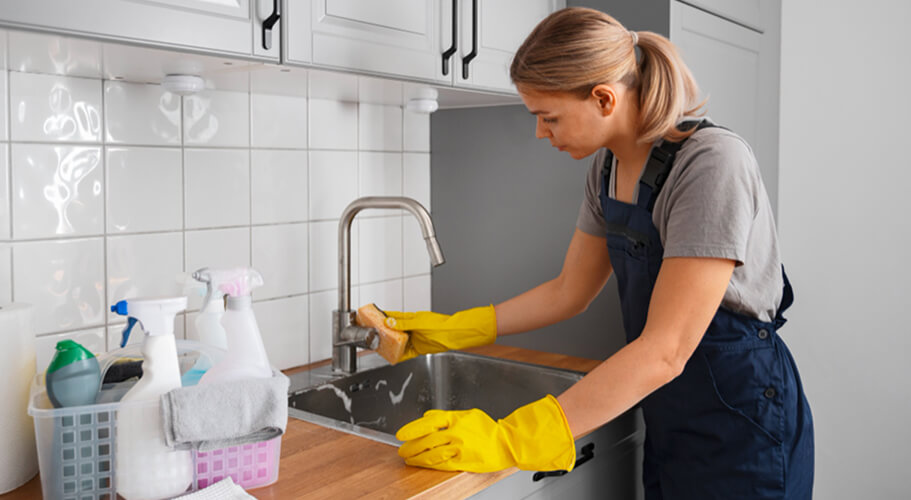
Most cleaning schedules you find online are written for a house nobody lives in. They assume nobody cooks on a weeknight, nobody has a dog, and everybody has a spare Saturday. Here is a more honest version — what genuinely needs doing at each interval, and what you can leave alone longer than you think.
Every day: about ten minutes
The daily list is short on purpose. Its only job is to stop small messes from compounding into a weekend write-off.
- Wipe kitchen benches and the cooktop after the last meal, while it is still warm and nothing has set
- Run the sink empty and wipe it dry — a dry sink is the difference between a kitchen that looks clean and one that does not
- Squeegee or towel the shower screen after the last shower of the day
- Do a two-minute reset of the room you actually use — cushions, remotes, whatever migrated onto the floor
None of that is really cleaning. It is maintenance, and it is the single biggest factor in how much work the weekly clean turns out to be.
Every week
This is the real clean, and it is what a scheduled regular clean covers.
- Bathrooms: toilets, basins, shower, taps and mirrors. Weekly is the point where soap scum still wipes off instead of needing to be scrubbed
- Kitchen: splashback, appliance fronts, the microwave inside, and the bin
- Floors: vacuum throughout, mop hard floors
- Dusting: surfaces, shelves, sills and skirting boards at eye level and below
- Linen: sheets and bath towels
If you can only protect one interval, protect this one. Almost every "the house has got away from me" call we take is a weekly clean that quietly became a fortnightly one, then a monthly one.

Every month
Monthly jobs are the ones nobody notices until they are skipped for a year.
- Wipe down doors, door frames and light switches — the highest-traffic surfaces in the house and the least cleaned
- Vacuum upholstery and under cushions
- Clean the inside of the fridge, shelf by shelf as it empties
- Wash the rangehood filter
- Dust ceiling fans, light fittings and the tops of wardrobes
Two to four times a year
Seasonal work is where a deep clean earns its keep, because most of it needs either time, equipment or a willingness to move heavy things.
- Oven, including racks and the door glass
- Behind and underneath the fridge, oven and washing machine
- Window tracks and sills, and the windows themselves
- Grout, shower seals and tile edges
- Carpets and rugs
- Curtains, blinds and flyscreens
- Inside cupboards and the pantry
Where the schedule usually falls over
Three things break a cleaning routine, and none of them are laziness.
The list is too long
A weekly list with twenty items gets abandoned in week three. A list with six gets done for years. Cut it until it is genuinely achievable on your worst week, not your best one.
Everything is scheduled for Saturday
Stacking the whole house into one block makes it a project, and projects get postponed. Spreading it — bathrooms one evening, floors another — is less satisfying but far more durable.
The seasonal jobs never get a date
Daily and weekly tasks have natural triggers. Quarterly ones do not, so they drift indefinitely. Put them in a calendar or hand them to someone else.
A reasonable split: keep the daily ten minutes and the weekly reset yourself, and book the seasonal work out. That is the pattern most of our regular clients settle into — a fortnightly visit for the weekly list, and a deep clean before Christmas and again in winter.
What if you are already behind?
Do not try to start a weekly routine on a house that needs a deep clean. It will not hold, because every weekly session gets swallowed by backlog and never feels like progress. Reset it once properly, then start the schedule from a clean baseline. That is exactly what a one-off deep clean is for.
If you are not sure which you need, describe the place to us and we will tell you honestly — including if the answer is that a regular clean is enough.